


Field School
)
Jankowo Dolne
Jankowo is a small village located 10 km east of Gniezno, the nearest county town, in the province of Wielkopolska. Nestled in a charming landscape, the village attracts many tourists and hikers, but only few know about its historical and archaeological heritage. Jankowo's heyday came in the Middle Ages (14th and 15th centuries), when settlements concentrated around two prominent hills. On one of them, a knights’ manor house was built, and on the other, a parish church and cemetery were located. Today's archaeological site comprises two interconnected structures: the relics of a parish church with a cemetery and a vast manor complex. Together, they form a unique settlement site, an example of a small, feudal defensive structure with an adjacent, local religious center.
)
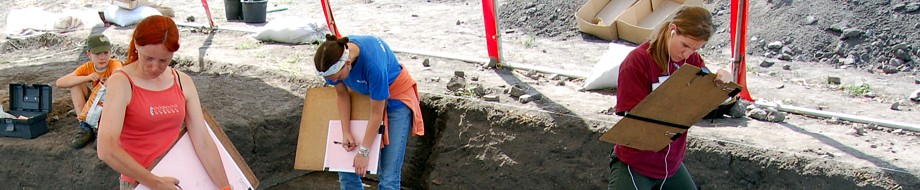
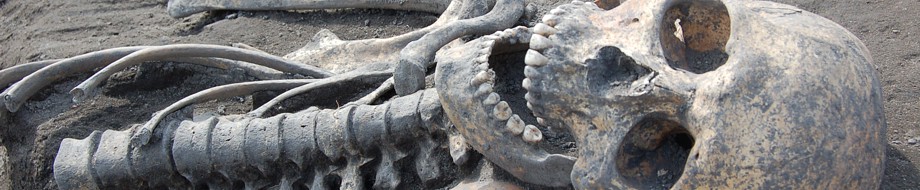
Archaeological research conducted in the 1990s on the grounds of the manor house yielded spectacular discoveries. Not only were relics of the walls uncovered, but also a vast collection of various artefacts: thousands of fragments of ceramic vessels, glass, iron tools and fittings, and coins (ranging from 15th-century denarii to 17th-century shillings). On the neighboring hill, the parish necropolis was uncovered, along with relics of the church. During the excavations, over forty burials were discovered, oriented east-west, in accordance with Christian rites. The deceased were laid in simple coffins, sometimes with stone frames. The lack of richly furnished graves attests to the rural nature of the parish community. Remnants of the foundations suggest that the first church was a single-nave structure, rebuilt several times. The excavations also revealed traces of later demolition work, associated with the removal of subsequent churches in the 17th and 19th centuries. Unfortunately, in the 1990s, the skeletal remains were not documented in detail or subjected to anthropological analysis. The enormous cognitive potential of this site is still waiting to be discovered.
)
The Cathedral in Gniezno
The Slavia Project 2027 in Jankowo follows previous Slavia research conducted as part of the Mortuary Archaeology Field School at the rural funeral sites of Drawsko and Gać. Our new research project in Jankowo aims to provide insight into the life of the rural community of farmers over a 500-year period–from the 14th to the 19th century. The current archaeological research is expected to identify the spatial organization of the cemetery and its changes over the centuries, as well as to analyze the demographics and health of the population. Through archaeological excavations we plan to collect data which will shed light on migration, dietary patterns, and developmental stress markers. Various lines of evidence will be used in order to understand the adaptive and biological response of the Jankowo’s non-elite, rural population to the changing economic system and deteriorating climate conditions of early modern Poland.